|
|
|
|
From: The Line Of Fire
A Pizza Makers Odyssey By Ed LaDou
I moved out out permanently from my parents home when I was seventeen, shortly after I returned the last time from Connecticut. I rented a room over a garage behind a house when I found out a high school friend was moving. I had a waterbed, a small TV, a cushy chair, a hundred books, a stereo, and most importantly, an electric skillet and a two burner hot plate. The bathroom was downstair and was shared with the two tenants of the garage, a tenant who had a room over the house and one who lived in a trailer parked in the yard.
I began learning to cook out of necessity. I had to eat. Jim was a Vietnam Vet who lived in the room over the house near mine, and between pipe loads showed me that there were more spices than salt and pepper. He expounded on the virtues of garlic and herbs (dry) and took his cooking seriously. I was impressed and began utilizing his recommendations on my own simple fare.
The goal in those days seemed to be how to get by with the least effort. Work was always the last resort, and if you were wide eyed, opportunities presented themselves. I was living smack in the middle of a fairly affluent community, paying forty dollars a month for a one room flat, but I was resourceful. I knew where all the fruit trees were in the neighborhoods, as well as the walnut, almond and pecan trees. I studied Bradford Angiers books on how to live on nothing and to forage for and eat wild foods. He was my first mentor.
In the morning I would saunter over to dine under a grapefruit tree, then grab a few oranges on the way back to the pad. That and some good granola got me going for the day. Later I might tackle a few almonds, walnuts or whatever. In the hills I picked miners lettuce, dandelion leaves, wild parsley and onions. In the creeks watercress flourished. I wore moccasins, jeans and flannel shirts, and was accompanied everywhere I went with my best friend, Baron, a German Sheppard.
Reading the underground newspapers, I learned that the grocery stores routinely threw away perfectly good produce if it was even slightly blemished or bruised. I would sort through the bins behind the local Midtown Market and return home with potatoes, onions, celery, carrots and other staples. These would go into a large pot with water, some wild greens and seasonings, maybe some chunks of beef, maybe some rice and I would eat stew for days running.
I savored my resourcefulness and woods skills, and soon learned to appreciate my cooking abilities as well. I did in fact work on occasion, not being entirely destitute, and once or twice a week would go into the local market and read recipes from the cooking magazine rack. When I found one that interested me, I would put the book back, purchase the ingredients and figure out how to make it in an electric skillet.
At this time I was a promising poet, and always kept a journal/notebook in the back pocket of my jeans. I began entering recipes in these notebooks, marking my various culinary successes as well as mapping out where the good wild stuff grew. Some of these notebooks I still have, and believe it or not, some of the recipes I still use.
When I was eighteen I was sharing an apartment in Mountain View, California, with Bill Olson, still my best freind, and moving between jobs with a consistent inconsistency. At that time in my life I had no real career goals and worked to make ends meet. I painted houses, washed windows, helped on home repairs, packed flowers in a nursery, worked in a car wash and polished silicon wafers for a brand new industry that would later lend its name to the region.
One day a friend suggested I go the Woolworth's at the nearby shopping mall, as he was leaving his job as a cook. Woolworth's was a major department store chain that always featured a lunch counter in the store where shoppers could sit down and order burgers, club and grilled cheese sandwiches, french fries, shakes and other such fare. To my surprise I got the job. I think they were desperate to hire, as I had no experience and wore my hair quite long. It was approaching the Fall Holiday season and the mall was getting busy.
The manager told me to tuck my hair up under a hat and the waitresses explained the fundamentals of what to do, and suddenly I was a Cook. At Woolworth's the kitchen was behind the counter where customers sat, and there were booths and tables in front of that. The counter was U shaped, and the griddle and fryers were in full view of the diners. My first exhibition kitchen.
I was the sole cook during my shifts, and as Thanksgiving approached, business began to grow dramatically. As business increased, so did my skills. I took to this job like a fish to water. It had everything I liked. I was The Cook, and therefore in charge of the domain. I loved the interaction with the waitresses and bussers. I loved the theater of working before an audience. I loved the craft of cooking, assembling plates, reading tickets, the set up and the break down. I loved the pressure as orders began coming in, and tickets needed to be filled. I learned to shuffle burgers and buns from a stack onto the griddle. To deal slices of American cheese onto burgers from three feet away. To stack the lettuce with the tomato and have it ready, to have the onions grilling for the patty melt until brown and sweet. I loved the sizzle of fish and fries in the deep fryer, and I loved the action of using both hands to flip burgers deftly high into the air, so that I could reach the buns and catch the burgers on them as they fell. I learned to flip burgers over my shoulder and catch them on buns behind my back, and I learned to move with precision among hot equipment and cold foods, with a fluidity of motion that more resembled dancing than what I was capable of expressing at a Santana show.
I knew that I was being watched during this whole process, both by the servers as they waited for their orders to come up, and by the customers as well. I sucked it all up. I put a flair into everything I did, flipping my spatula, once, twice, three times over, catching it by the handle just in time to turn the meat.
I began learning how to group orders, a skill that many cooks daily struggle with. Grouping is one of the essentials of commercial cooking that home cooks have no clue about. When multiple tickets come in, the cook must speed read through the copy, and categorize the tasks ahead by order of priority. It’s not always as simple as first ticket in, first ticket out, although that rule is an essential parameter. Grouping means economizing ones motion by anticipating, as a chess player would, what steps ahead are needed to most quickly and efficiently complete the orders. One does not cook each order one at a time, but would cook enough within a group that will allow him the time needed to assemble the other components of that group, before proceeding onto the next. You do not cook too many, or too few. If you over group, the first items prepared will not be searing hot, and thus not meet the self imposed standard of excellence. It is a mathematical puzzle that needs to be determined in the time it takes to read through the tickets. Things that take longest are started first. Then one does the thing that takes the next longest, then the next, until the point of assembly comes together and in an instant the order is complete, each thing cooked perfectly and plated at the same time, one after the other, until all tickets are spindled, and its time to duck outside for a cigarette.
In more full service restaurants, grouping is often done table by table, if the tables are large (4 and up). If the cook is looking at a series of two tops, then often they are grouped into a collective by what they have ordered. For example, if one has to retrieve an order of fish or chicken, one retrieves enough to complete the group at hand, so that he is not moving back and forth needlessly. He takes four or five out, and then calculates the time needed to fill the other orders in around them. A good cook learns economy of motion without ever knowing it. When busy you get into what I call The Zone. You have constructed the entire sequence of the next few minutes events in your head, and when you begin, God forbid the idiot who interrupts your flow. This is one of the sources of battle between cooks and servers that is an ongoing factor in all kitchens. But working in The Zone is the reward one achieves for acquiring a specific level of competency.
The best and most efficient kitchens work in virtual silence. The assistants know when the right time to begin assembling plates by watching the lead, and anticipating his next move. Knowing by experience how long the fish will cook, and having the sauce ready when it is done, and not a minute too soon, and not a second, Goddamnit, too late.
In the very high end restaurants the chef actually works in a fashion similar to a symphony conductor, his glance and gesture and the occasional command to “Fire” a dish comprise a large part of dinner rush duty. He is there to ensure that all plates are properly “tuned”, all stations properly coordinated, and the execution as flawless as can be. Quite often these chefs would be lost if they were to do the actual cooking.
There is a epiphany of sorts, ongoing through a shifts service, when all the components come together in a choreographed dance, and each element of a dish is assembled at The Point it is supposed to, and the plate is placed for pick up within seconds of its assembly. Then moving onto the next with no pause, and then the next, until the last customer sits before the art that has been created. Working in The Zone, I suppose is similar to that of an athletes ability to completely focus on the task at hand, to react without thinking, to move instantly, and to anticipate each hurdle.
Occasionally, when grouping orders, a tables food may arrive ahead of a nearby table that ordered earlier. To the customer this can be a source of irritation. It doesn’t seem fair. But they don’t realize that the kitchen is capable of accelerating its cooking by grouping, and the first table, which usually is following on the heels of the second, has been prepared quicker than if the cooks followed the order in - order out - method. It’s not really about who goes first, but is the food properly prepared in a reasonable amount of time.
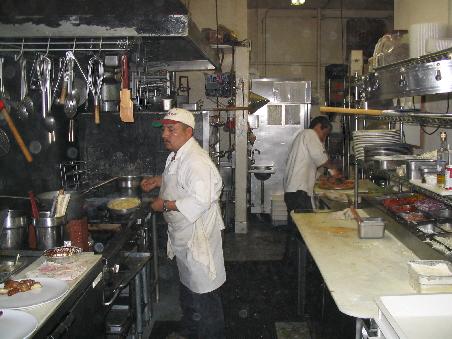
This type of cooking, called line cooking, is conceptually different then banquet cooking and catering. When applicants come in, proud of their banquet hotel experience or puffed up over the celebrity events they have catered, I look at them with skepticism. In these kind of affairs the grouping is the affair. Kitchens are set up in a military system. While it is impressive to get three hundred and fifty meals out in fifteen minutes it is not really cooking in the restaurant sense. Plates are pre-assembled and kept in large rolling food warmers, stations are set up a conveyor type line, and passed along, with each cook adding a component almost as if they worked on a automobile production line. Servers are not order takers per se, but runners who see to the table service pre plating up and afterward.
****************
Even while I worked at Woolworth's, I did not ever consider that cooking would be my life long occupation. It was a cool gig. One I started to really enjoy. Right when I started getting to the top of my form, they let me go.
I worked through both holiday seasons, but in February the mall action took a dramatic downturn. Management decided that as business slowed down they would cut staff (me), and let the servers cook their own occasional meal. I was pretty disappointed. I kinda felt that I deserved to coast a bit, after slamming through the holiday crush for them. And what I really couldn’t fathom was letting the servers cook. How weird is that?
One of the things that sticks in my mind about Woolworth's was that they paid all employees in cash. On payday you picked up a pay envelope with the deductions written out on the front by the bookkeepers hand, and inside was your net pay, to the penny. I think I made a little above minimum wage at that job, somewhere around $1.65 an hour. Those were good days still, when cigarettes cost .50 a pack and a 12 pack of Lucky beer was 1.99. My roommate Bill and I split the rent on our two bedroom apartment, which was $160 a month.
Those few months at Woolworth's were, up to that point, the longest regular job I had had. I soon fell back into my previous inconsistency, working jobs here and there. At one point I took a job at Der Weinershnitzel, a fast food hot dog franchise. I remember that I had to go out and buy shoes, black pants and a white shirt. This set me back about 7 bucks at the local Goodwill, which was a lot, considering I made about 27.00 on the first weeks pay check. The first week was spent, to a large part, watching a slide presentation in the managers office outlining operations and procedures. By the second week, I was outta there, bored to death at watching the french fry machines automatic timer light.
|
|
|
|
|